How to Buy Targeted Email Lists and Email Marketing Databases That Actually Deliver Results
Most email marketing campaigns fail before a single word is read. The problem rarely sits in the subject line or the design - it sits in the audience. Sending well-crafted messages to the wrong people produces predictable outcomes: low engagement, high unsubscribes, and a sender reputation that quietly deteriorates with every campaign. The fundamental challenge of email outreach is not creative; it is structural. You need the right contacts.
For businesses that cannot afford to wait months for organic list growth, purchasing targeted contact data is a legitimate and widely practiced approach. The market for email leads for sale spans everything from carefully curated, consent-backed professional databases to bulk lists of questionable origin sold at suspiciously low prices. Knowing which is which - and knowing what to do with a list once you have it - separates campaigns that generate pipeline from campaigns that generate complaints. Marketers searching for an email address for sale often underestimate how dramatically provider quality, segmentation depth, and technical preparation shape the final result.
This guide covers the full process: understanding list types, navigating legal obligations, evaluating providers, defining precise targeting criteria, integrating contacts into your infrastructure, measuring performance, and avoiding the mistakes that consistently undermine purchased list campaigns. Every section is designed to give you practical, actionable knowledge rather than general reassurance. The goal is a campaign that performs - and a process you can repeat with confidence.
Understanding What Purchased Email Lists Actually Are
Before committing budget to any email marketing database, you need a clear picture of what the market actually offers. The terminology used by providers is often inconsistent, and the differences between list types carry enormous consequences for deliverability, compliance, and campaign performance.
At its most basic, a mailing list for purchase is a collection of contact records compiled from external sources. Those sources vary widely: opt-in web forms, professional directory aggregation, survey participation, event registrations, publisher networks, and consumer data brokers. What matters most is not just where the data came from, but how recently it was verified, how carefully it was segmented, and whether the contacts have any meaningful connection to third-party marketing communications.
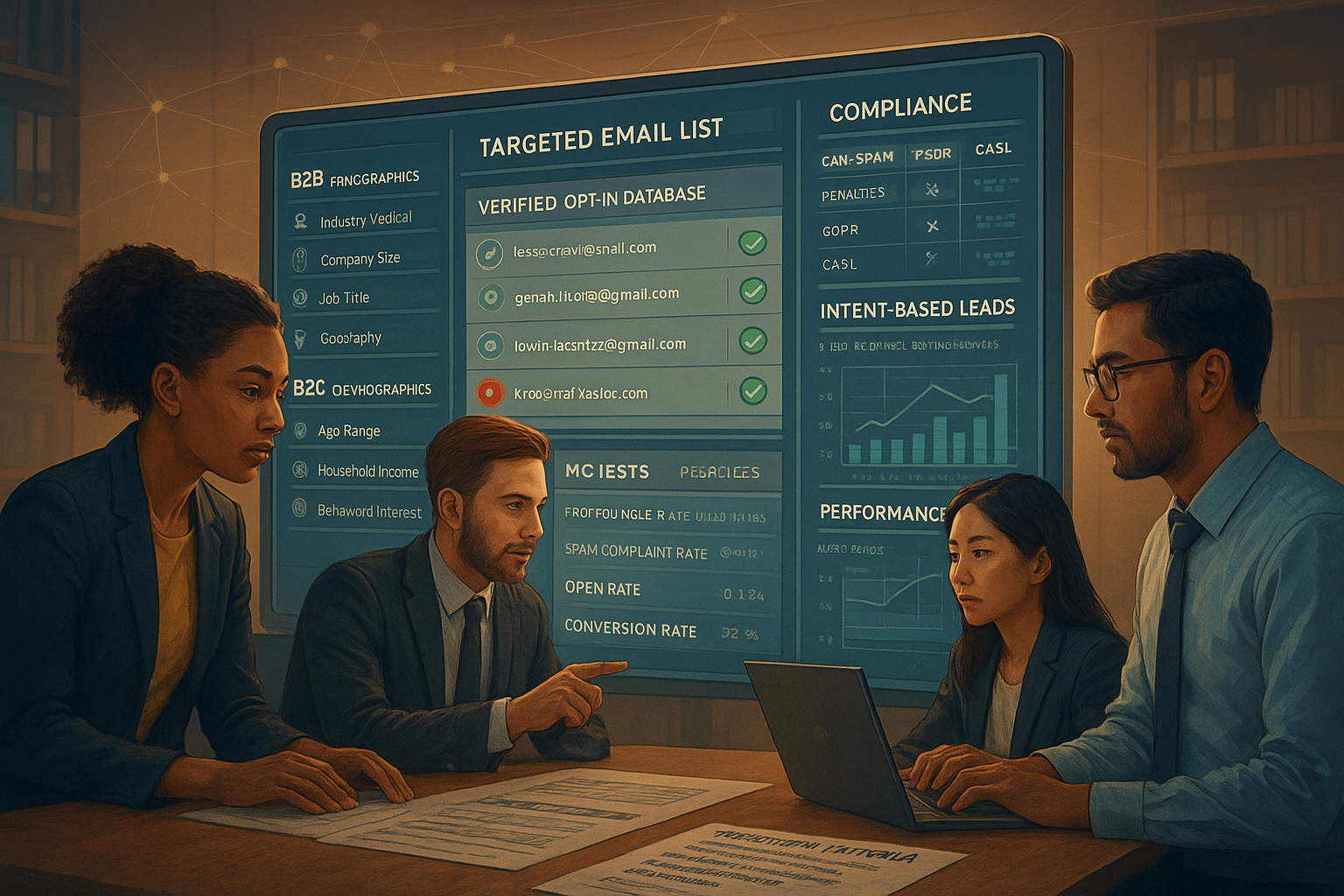
Targeted email contacts are records filtered against specific criteria relevant to your campaign. For a B2B software company, that might mean filtering by industry vertical, company size, and job function. For a consumer retailer, it might mean filtering by geography, age range, and purchase interest. The more precisely the data matches your ideal recipient profile, the higher the engagement you can expect and the lower the operational risk from bounces and complaints.
Email leads for sale represent a more intent-qualified tier of contact data. A lead, in this context, implies some signal of relevance - a recent search, a content interaction, or an inquiry within a related category. Intent-qualified contacts generally convert at a higher rate than passive list records because the behavioral signal reduces the gap between cold outreach and genuine interest.
- Generic bulk lists: high volume, minimal segmentation, elevated risk of outdated or invalid addresses
- Niche segmented lists: filtered by industry, role, geography, or behavior, significantly higher relevance
- Verified opt-in databases: contacts have explicitly agreed to receive third-party marketing communications
- Intent-based leads: contacts showing recent buying signals or active engagement with a relevant category
- Compiled professional directories: sourced from public business records, typically used for B2B outreach
Understanding which category you are purchasing - and whether it aligns with your campaign objective - is the foundation of every subsequent decision. Treating all purchased contact data as equivalent is one of the most expensive assumptions a marketer can make.
Legal and Compliance Considerations Before You Buy
The legal frameworks governing commercial email are real, enforced, and jurisdiction-specific. Marketers who treat compliance as a formality tend to discover its importance only after a complaint, a platform suspension, or a regulatory inquiry. The better approach is to understand the rules before spending anything on a mailing list for purchase.
Key Regulations That Govern Email Marketing to Purchased Lists
Three regulatory frameworks dominate the email marketing compliance landscape. Each takes a distinct approach to permission, and each applies to different geographies. Knowing which applies to your contacts is not optional - it is the baseline requirement for lawful outreach.
CAN-SPAM governs commercial email sent to recipients in the United States. Crucially, it operates on an opt-out model rather than a prior-consent model. This means purchasing a list and emailing US recipients is legally permissible under CAN-SPAM, provided you meet specific requirements: the sender must be clearly identified, subject lines must not be deceptive, every email must include a physical mailing address, and recipients must have a functional mechanism to opt out that is honored within ten business days. Violations carry civil penalties of up to $50,000 per individual email.
GDPR, which applies to personal data belonging to individuals located in the European Union, takes the opposite approach. Under GDPR, processing personal data for marketing purposes requires a lawful basis. Consent is the most common basis in this context, and it must be freely given, specific, informed, and unambiguous. Some organizations attempt to rely on legitimate interests as an alternative basis for cold outreach, but this requires a genuine balancing test and carries material enforcement risk. GDPR penalties can reach four percent of global annual turnover, which makes noncompliance a significant financial exposure for any business of scale.
CASL, Canada's anti-spam legislation, is the most restrictive of the three. It requires express consent before sending commercial electronic messages to Canadian recipients, with narrow exceptions for implied consent based on an existing business relationship. Penalties under CASL can reach three million Canadian dollars per violation for organizations.
| Regulation | Jurisdiction | Consent Requirement | Key Obligation | Maximum Penalty |
|---|---|---|---|---|
| CAN-SPAM | United States | Opt-out model - no prior consent required | Honest sender identification, functional opt-out | $50,000 per email |
| GDPR | European Union | Opt-in model - lawful basis required | Consent documentation, data minimization | 4% of global annual turnover |
| CASL | Canada | Express consent model | Identified sender, unsubscribe mechanism | CAD $3 million per violation |
What to Verify in a Provider's Compliance Claims
Every provider of email marketing databases will assert that their data is compliant. That claim is only as reliable as the documentation behind it. Before purchasing any list, request specific evidence rather than accepting general assurances.
- Data collection methodology with documentation of source types
- Evidence of opt-in consent where the target geography requires it
- Date of last list verification and cleaning
- Compliance with data protection laws applicable to the contacts' locations
- Clear terms covering data ownership, exclusivity, and resale restrictions
- Provider's privacy policy and willingness to sign a data processing agreement
Any provider who deflects these questions, provides vague answers, or refuses to supply documentation in writing should be treated as a serious red flag. The compliance burden sits with the sender, not the data vendor. If a regulator investigates your campaign, the fact that a vendor claimed the data was compliant provides no legal protection unless you can substantiate the claim with verifiable records.
Practical Steps to Protect Your Business Before Sending
Even a legitimately sourced purchased list requires pre-send compliance preparation. Run every list through an independent email verification tool to remove invalid, inactive, and role-based addresses. Identify and suppress contacts from jurisdictions where your legal basis for outreach is uncertain. Deploy your purchased list campaigns from a dedicated sending subdomain, not your primary domain, to contain any reputational risk. Ensure your unsubscribe mechanism is technically functional before the first send, and configure your platform to process opt-outs immediately. Maintain internal records of your compliance rationale - the source of the data, the legal basis claimed, and the verification steps taken - in case those records are ever needed.
How to Evaluate and Choose the Right Email List Provider
The quality of any purchased list campaign is determined, more than any other single factor, by the quality of the provider. The market spans a wide spectrum. On one end are professional data companies that invest heavily in collection methodology, verification infrastructure, and compliance documentation. On the other end are low-cost operations reselling outdated, fabricated, or recycled records with no meaningful quality control. Distinguishing between them requires a structured evaluation process.
Criteria for Assessing Provider Quality
Apply the following criteria consistently when evaluating any provider offering targeted email contacts or bulk email marketing databases. These factors are the most reliable predictors of list performance and long-term sender safety.
| Quality Criterion | What to Look For | Red Flag Indicators |
|---|---|---|
| Data freshness | Verification within the last 90 days | No stated verification date or data older than 12 months |
| Source transparency | Documented collection methods and origin types | Vague or evasive answers about how data was gathered |
| Deliverability guarantee | Provider commits to a validity rate above 90% | No deliverability claim, refusal to provide a sample |
| Segmentation depth | Multiple filtering options across industry, role, and geography | Only bulk packages with no targeting flexibility |
| Compliance documentation | Consent records and willingness to sign a data processing agreement | No reference to applicable legal frameworks |
| Customer support quality | Responsive, knowledgeable pre-sale engagement | Automated responses only, no accessible support channel |
| Replacement or refund policy | Clear recourse for invalid or bouncing contacts | No post-purchase policy stated or available |
B2B vs. B2C List Providers: Key Differences
The dynamics of buying email lists shift significantly depending on whether you are targeting businesses or consumers. Understanding these differences helps you match your sourcing strategy to your campaign context.
B2B email marketing databases are typically built from professional directories, company registration data, industry event participation, and aggregated professional profile information. They are priced higher per contact, tend to have stronger compliance protections in many jurisdictions because professional contact details occupy a different legal category than personal consumer data, and generally have a longer useful lifespan because professional roles change more slowly than personal email addresses.
B2C lists draw from a broader range of sources: consumer survey platforms, e-commerce registration data, publisher opt-in networks, and aggregated lifestyle data. They require stricter consent documentation under GDPR and CASL, are more sensitive to data privacy regulation, and decay faster as people change personal email addresses, alter their interests, or simply become less active on certain platforms. Targeting for B2C lists focuses on demographics, geographic location, and interest or behavior categories rather than the firmographic variables relevant to B2B.
- B2B list strengths: professional context, firmographic segmentation depth, longer data validity period
- B2B list limitations: smaller available universe, higher cost per contact, longer buyer decision cycles
- B2C list strengths: larger addressable audience, interest and behavior filtering, broad reach potential
- B2C list limitations: stricter consent requirements in key jurisdictions, faster data decay, higher competitive noise
Testing a Provider Before a Full Purchase
No provider evaluation is complete without a practical test. Request a sample of one hundred to five hundred contacts segmented to your target profile before committing to a full purchase. Run that sample through an independent third-party verification service - not the provider's own verification tool - to assess the actual validity rate. Send a small campaign to the verified sample and measure hard bounce rate, open rate, and spam complaint rate before scaling.
A provider who declines to offer a sample, insists on a full purchase upfront, or makes verification difficult is telling you something important about the quality of their data. Invest the time in this testing step. It is the most reliable filter available, and the cost of a small test is negligible compared to the cost of deploying a full campaign to a low-quality list.
How to Define Your Targeting Criteria for Maximum Campaign Relevance
Volume without precision is not an asset in email marketing - it is a liability. A list of one hundred thousand addresses that do not match your audience will generate worse results, and more compliance risk, than a list of five thousand contacts who closely fit your ideal recipient profile. Defining your targeting criteria before approaching any provider is the strategic decision that determines everything else.
B2B Targeting Variables
For business-to-business campaigns, the most actionable segmentation dimensions fall into two categories: firmographic variables that describe the company, and role-based variables that describe the individual contact. Quality B2B providers can filter on most of the following criteria, though availability varies by market and data source.
- Industry vertical, typically categorized by standard classification codes or plain-language sector descriptions
- Company size by employee headcount, segmented across small business, mid-market, and enterprise tiers
- Company size by annual revenue
- Job title and seniority level, from C-suite and VP to director, manager, and practitioner
- Functional department such as marketing, finance, IT, operations, or human resources
- Geographic location at country, region, city, or postal code level
- Technology stack where available, identifying tools and platforms currently in use
- Ownership structure or funding stage such as VC-backed, publicly traded, or privately held
B2C Targeting Variables
Consumer-facing campaigns require a different set of filters. When evaluating options for a mailing list for purchase targeting individual consumers, the relevant segmentation variables shift toward demographic characteristics and behavioral signals.
- Age range and gender
- Geographic location from country level down to postal code
- Household income bracket
- Purchase history or product category interest
- Lifestyle and interest categories such as fitness, travel, home improvement, or finance
- Homeownership status or household composition
- Recent life events including new parenthood, relocation, or educational milestones
Matching List Targeting to Campaign Objectives
Different objectives call for different targeting priorities, and conflating them produces lists that serve no objective well. A lead generation campaign for enterprise software should weight job seniority, department function, and company size over geography. A retail promotion targeting urban consumers should prioritize location, income, and interest category over demographic breadth.
Before requesting any list, write your campaign objective in a single sentence. Then map each targeting variable you are considering to a specific reason it increases message relevance for that objective. Remove any variable you cannot connect to a clear rationale. This discipline prevents over-segmentation that reduces list size to an unworkable volume, and it prevents under-segmentation that dilutes relevance and inflates bounce and complaint rates. The targeting definition is not a pre-purchase formality - it is the core of your campaign strategy.
Integrating Purchased Lists into Your Email Marketing Workflow
A validated, targeted list is an input, not an outcome. What you do with it operationally - how you prepare your sending infrastructure, warm up your domain, and structure your campaign sequence - determines whether the investment pays off or creates problems. Many campaigns using purchased contact data fail not because the data was poor, but because the technical and strategic groundwork was skipped.
Technical Preparation Before Sending to Purchased Contacts
Deploying a campaign to a cold purchased list without proper infrastructure preparation is one of the most reliable ways to damage your sending reputation. Complete each of the following steps before sending a single message.
- Create a dedicated sending subdomain, separate from your primary transactional email domain, to contain reputational exposure from cold outreach
- Configure SPF, DKIM, and DMARC authentication records for the new sending domain to establish technical legitimacy with receiving mail servers
- Pass the purchased list through a third-party email verification tool to identify and remove invalid addresses, role-based inboxes, and known spam traps
- Suppress any addresses already present in your CRM, previous unsubscribe lists, or known complaint history
- Divide the verified list into batches for gradual volume ramp-up rather than deploying the full list in a single send
- Confirm that your sending platform processes unsubscribe requests immediately and logs all opt-outs for ongoing suppression
- Set up monitoring for bounce rate, spam complaint rate, and open rate from the first send so that problems are caught early
Warming Up a New Sending Domain
Receiving mail servers and corporate email gateways evaluate sender reputation based on the behavioral history of an IP address and domain. A subdomain with no sending history that suddenly dispatches large volumes of email will trigger spam filters regardless of content quality. This is not a judgment about your message - it is an automated infrastructure response to an unfamiliar pattern.
Warming up a sending domain means gradually increasing volume over two to four weeks, starting with small daily batches sent to the most engagement-ready segments of your list. As positive signals accumulate - opens, clicks, replies - you scale sending volume upward. Most reputable email sending platforms offer automated warmup workflows, but manually managing the process provides more direct control over pacing and allows faster response to early warning signs in your deliverability metrics.
Campaign Structure Recommendations for Cold Purchased Lists
Contacts from a purchased list are cold. They have no existing relationship with your brand and no particular expectation of hearing from you. A single promotional email sent to this audience without context will produce predictable results: high unsubscribes, elevated complaint rates, and minimal conversion. A structured multi-email sequence that establishes relevance before making an ask consistently outperforms single-send approaches.
| Email in Sequence | Purpose | Tone | Call to Action |
|---|---|---|---|
| Email 1 | Introduction and relevance establishment | Informative, low-pressure | Soft: read a resource or learn more |
| Email 2 | Value delivery through insight, case example, or guide | Educational and helpful | Engagement: download, reply, or explore further |
| Email 3 | Problem-solution framing relevant to the audience's context | Consultative | Moderate: book a call or request a demonstration |
| Email 4 | Offer presentation supported by social proof | Direct but respectful | Primary conversion: purchase, sign up, or contact |
| Email 5 | Final follow-up for non-responders | Concise and outcome-focused | Final call to action or opt-out acknowledgment |
Measuring Results and Optimizing Your Email List Campaigns
Purchasing email leads for sale is an investment that requires a measurable return. Without defined performance metrics and regular analysis, it is impossible to distinguish a high-performing list segment from a damaging one, or to evaluate whether the cost per acquisition from purchased contact data justifies continued spend. Measurement is not a post-campaign activity - it informs every decision from the second send onward.
Key Metrics to Track for Purchased List Campaigns
Campaigns using bought contact data require closer attention to deliverability indicators than organic subscriber campaigns, because the cold nature of the audience creates greater variance at the infrastructure level. The following benchmarks provide practical reference points, though exact figures vary by industry and audience type.
| Metric | Healthy Benchmark | Warning Threshold | What It Reveals |
|---|---|---|---|
| Hard bounce rate | Below 2% | Above 5% | List data quality and pre-send verification effectiveness |
| Spam complaint rate | Below 0.1% | Above 0.3% | Targeting relevance and message-to-audience fit |
| Open rate | Varies by industry, typically 15-25% | Below 10% | Subject line effectiveness and sender reputation |
| Click-through rate | 2-5% | Below 1% | Content relevance and call-to-action clarity |
| Unsubscribe rate | Below 0.5% per send | Above 1% | Audience fit and sending frequency appropriateness |
| Conversion rate | Varies by offer and objective | Significantly below organic list average | Overall campaign effectiveness and ROI |
Optimizing Based on Performance Data
Performance data from purchased list campaigns should actively shape every subsequent decision. A high bounce rate after pre-send verification points to either a verification tool limitation or a data quality problem at the provider level. Elevated spam complaint rates signal targeting misalignment - the message is reaching people who have no frame of reference for why they are receiving it. Low open rates may reflect subject line weaknesses, sender name unfamiliarity, or suboptimal send timing.
After the first two emails in your sequence, segment the list by engagement status. Contacts who have opened or clicked should be treated as warming prospects and moved into a more personalized follow-up track. Contacts with no engagement after two sends should receive one final re-engagement message before being permanently suppressed. Sending repeatedly to non-engaged contacts on a cold list accelerates reputation damage without any compensating return.
- A/B test subject lines across segments before full deployment to establish baseline performance
- Test send time and day of week to identify patterns specific to your cold audience
- Evaluate each list segment's performance independently to surface high-value targeting combinations
- Compare cost per conversion from purchased lists against other acquisition channels on a regular basis
- Move converted contacts into your CRM for ongoing organic nurture rather than treating them as a one-time campaign asset
Common Mistakes to Avoid When Buying Email Lists
The patterns that undermine purchased list campaigns are well-established and largely preventable. They recur across industries and business sizes, and they share a common root: treating bought contact data as a shortcut rather than as a starting point that requires careful handling.
- Prioritizing volume over relevance: Buying the largest available list rather than the most precisely segmented one is the most frequent cause of poor return from any buy email lists investment. A smaller, well-targeted list delivers better performance at lower operational cost than a large generic one.
- Skipping independent list verification: Even quality providers experience some data decay between their verification cycle and your purchase date. Running every list through a third-party verification tool before sending is a non-negotiable step that protects your sender reputation and prevents avoidable bounce spikes.
- Sending immediately from a new subdomain: Deploying high volumes from a domain with no sending history triggers spam filters at the infrastructure level before recipients evaluate the content. Warmup is not optional for cold list campaigns.
- Using your primary domain for cold outreach: Reputational damage from purchased list campaigns can contaminate deliverability for your transactional, onboarding, and relationship emails. The subdomain separation is a protective measure, not an administrative preference.
- Treating purchased and organic lists as interchangeable: Merging cold purchased contacts with a warm subscriber list distorts engagement metrics and risks degrading the reputation you have built with an audience that already knows your brand.
- Assuming a single purchase solves an ongoing need: Contact data decays. Addresses become inactive, professionals change roles, and domains expire. A single list purchase has a finite useful window; refreshing your database periodically is a necessary part of any sustained outreach program.
- Failing to request compliance documentation: Accepting a provider's verbal claim that their data is compliant without supporting documentation leaves you fully exposed if a contact, platform, or regulator challenges the legality of your outreach.
- Ignoring deliverability signals after the first send: Problems that are small at the first email become serious by the third if they are not caught and addressed. Monitoring bounce rate, complaint rate, and inbox placement throughout the campaign sequence is essential, not optional.
Questions and Answers
Can I use a purchased email list with mainstream email marketing platforms like Mailchimp?
Most mainstream email marketing platforms explicitly prohibit importing purchased lists in their terms of service and may suspend accounts that violate this policy. For cold outreach to bought contacts, you are better served by dedicated cold email tools or direct SMTP solutions designed for this use case. Once purchased contacts engage positively and opt into your communications explicitly, they can typically be migrated to your primary platform.
How do I calculate whether buying email contacts is worth the cost compared to other channels?
Calculate cost per acquisition from your purchased list campaign by dividing total spend - including list cost, platform fees, and time - by the number of converted contacts. Compare that figure against your cost per acquisition from paid advertising, content, or events. If the purchased list channel delivers a comparable or lower cost per acquisition with acceptable compliance risk, it earns its place in the mix. The first campaign from a new provider should be treated as a paid test, not a full-scale deployment.
What hard bounce rate should I expect after running a purchased list through email verification?
A high-quality list from a reputable provider, additionally verified through an independent tool, should produce a hard bounce rate below two percent on send. Without independent pre-send verification, bounce rates from purchased lists can climb significantly higher, particularly if the data is more than six months old. If your bounce rate exceeds five percent even after verification, the underlying list quality is inadequate and continued sending from that data will damage your sender reputation.
Is it possible to build a compliant purchased list campaign for EU audiences under GDPR?
It is possible but requires significant due diligence. You need a documented lawful basis for contacting EU recipients, and in most marketing scenarios that means verifiable prior consent rather than a claimed legitimate interest. Request full consent documentation from your provider, restricted to the specific types of communications you intend to send, and be prepared to demonstrate that basis if challenged. For most businesses without robust legal resource, limiting purchased list campaigns to US audiences under CAN-SPAM is the lower-risk starting point.
How often should I refresh or replace a purchased email database?
Professional B2B contact data should be reverified at a minimum every six months, with full database replacement or augmentation annually. B2C consumer data decays faster and warrants reverification every three to four months. Practical signals that a list has aged past its useful point include a rising hard bounce rate on otherwise technically sound campaigns, declining open rates, and a growing proportion of addresses returning permanent errors on verification.