How to Find and Secure Affordable Email Accounts: A Complete Guide to Email Account Marketplaces
Most people create email accounts one at a time, through official registration pages, with a unique phone number and a fresh IP address. That approach works fine for personal use. But for anyone managing digital marketing campaigns, running software testing environments, operating multiple business identities, or simply maintaining strict online privacy, manual registration quickly becomes impractical. The process is slow, often blocked by automated detection systems, and difficult to scale.
That friction has driven the growth of a parallel ecosystem: dedicated platforms where pre-registered accounts are listed, priced, and sold to buyers with specific operational needs. If you want to buy email account inventory without the overhead of creating each one yourself, these marketplaces have matured significantly over the past several years, offering everything from fresh accounts to aged, phone-verified listings in bulk quantities.
The challenge is that this market also attracts fraud, poor-quality inventory, and sellers with no accountability. Knowing how to identify reputable sources, evaluate account quality before spending money, and protect every account after purchase makes the difference between a productive acquisition and a complete waste of resources. This guide covers each of those stages in practical detail - from understanding how marketplaces function to making sure every account you acquire remains fully under your control.
Understanding the Email Account Marketplace Ecosystem
An email account marketplace is a platform - either a standalone website or a section within a broader digital asset exchange - where pre-registered email accounts are listed for sale by individual sellers or bulk suppliers. Buyers browse listings filtered by provider, account age, verification status, or quantity, then complete a purchase and receive credentials, typically delivered automatically or within a short fulfillment window.
These platforms exist because legitimate demand for ready-made accounts is substantial and consistent. Affiliate marketers need separate accounts for different campaigns. Software developers require test accounts across multiple providers. Businesses running outbound email programs need volume that manual registration cannot support. Privacy-focused individuals want accounts with no connection to their real identity. Each of these use cases is served by the marketplace model in a way that individual account creation cannot match efficiently.
Understanding the terminology used across these platforms helps buyers make better decisions from the start.
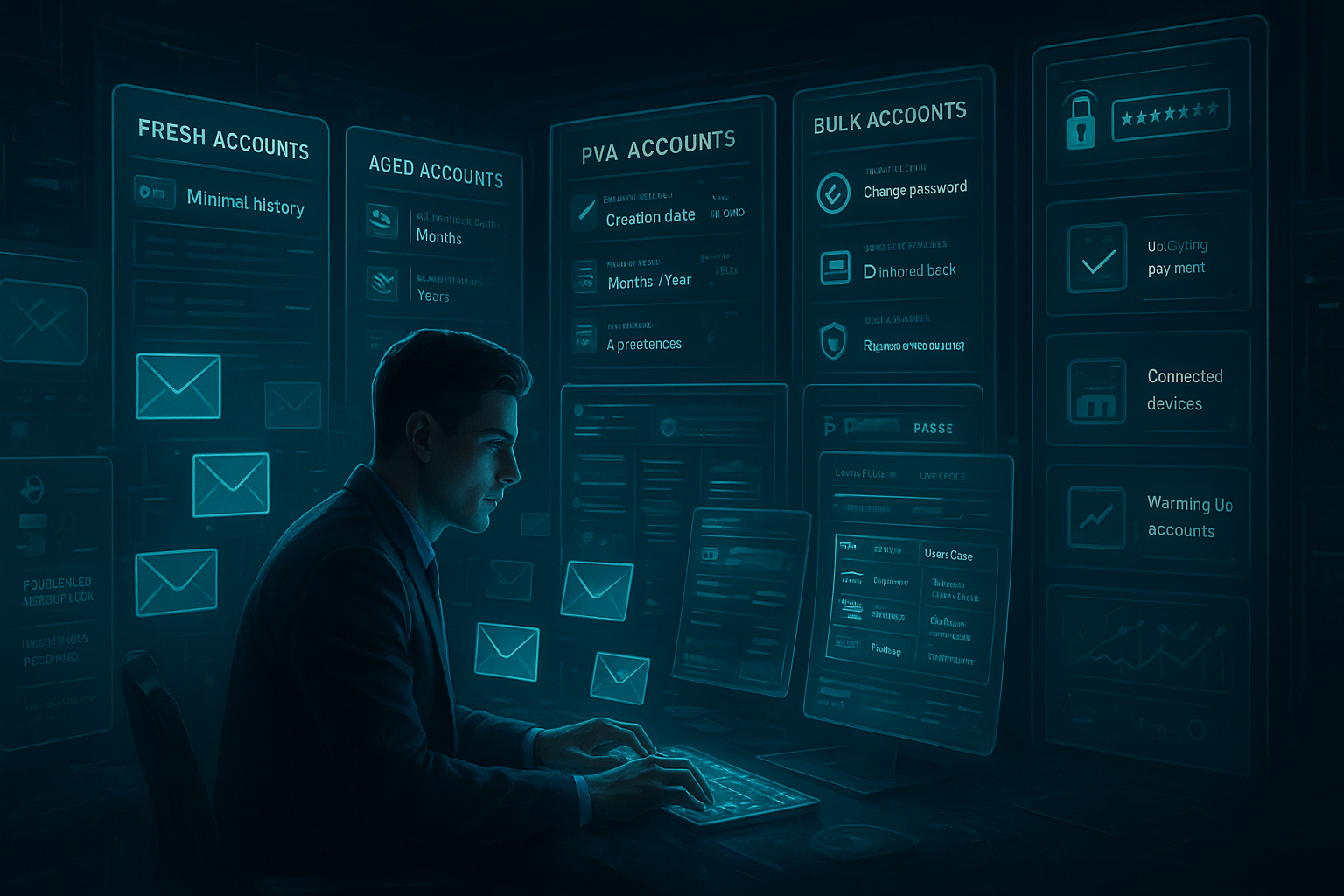
- Fresh accounts: Newly created accounts with little or no usage history, suitable for basic testing or entry-level outreach.
- Aged accounts: Accounts created months or years before sale, carrying more platform trust and lower suspension risk.
- PVA accounts: Phone-verified accounts, meaning a real phone number was used during registration, which increases account stability on most platforms.
- Bulk accounts: Large quantity packages sold at a reduced per-unit price, intended for campaigns or automation at scale.
The type of account that suits your needs depends entirely on your intended use. A developer testing a login flow has different requirements from a marketer running a multi-step outreach sequence. Matching account type to use case is the first decision every buyer should make before looking at any listing.
| Account Type | Description | Common Use Cases | Relative Price |
|---|---|---|---|
| Fresh accounts | Newly created, minimal history | Testing, low-stakes outreach | Low |
| Aged accounts | Created months or years prior to sale | Marketing, trusted communication | Medium to high |
| PVA accounts | Verified with a real phone number | Platforms requiring higher trust signals | Medium |
| Bulk accounts | High-quantity packages | Mass campaigns, automation | Low per unit |
Sellers on these platforms range from individuals who register accounts manually in small batches to automated suppliers offering thousands of units per day. The quality gap between these seller types is significant, which is why understanding the structure of the market - not just the listings - is foundational to buying well.
Key Factors to Evaluate Before You Purchase an Email Account
Browsing a marketplace and selecting the cheapest listing is how most buyers end up disappointed. Price is visible immediately; quality takes deliberate evaluation. Before you decide to purchase email account listings from any seller, five factors consistently separate reliable inventory from wasted spend.
Account Age and Activity History
Account age is one of the strongest predictors of post-purchase stability. Email providers assign varying levels of trust to accounts based on how long they have been active. An account created two years ago and used for regular correspondence carries substantially fewer red flags than one registered last week. When an aged account is suspended, it typically takes a specific behavioral trigger to cause it - whereas a fresh account may be flagged simply by existing in an unusual environment.
Ask sellers to confirm the creation date and, where possible, request any documentation of prior activity. Not all sellers provide this, but reputable ones on established platforms generally can. If a seller cannot confirm basic account metadata, that is itself informative.
Verification Status and Recovery Options
Phone-verified accounts are more resistant to early suspension because they passed a higher threshold during registration. When evaluating any email account for sale, confirm whether it is PVA and which country the verification number was associated with - some platforms treat verification numbers from specific regions differently.
Recovery access is equally important. An account that arrives without backup recovery options - an associated secondary email, recovery phone number, or backup codes - is one you cannot fully secure after purchase. If the original verification phone number remains linked and under the seller's control, your ownership of that account is always partial. Prioritize accounts that come with full recovery credential transfer.
Seller Reputation and Feedback
On any functioning email account marketplace, the seller's transaction history is the most reliable proxy for inventory quality. Read recent feedback carefully rather than relying on aggregate scores alone - a seller with a high overall rating but several recent negative reviews about non-functional accounts is a warning, not a reassurance.
Look for specific feedback rather than generic praise. Comments that mention account longevity, successful use in a particular context, or responsive support after delivery indicate a seller who stands behind their inventory. Generic five-star reviews with no substantive detail are easier to manufacture and less informative.
Replacement and Refund Policies
Even well-sourced accounts occasionally fail on delivery - passwords don't work, accounts have been suspended between listing and sale, or credentials are delivered incorrectly. A seller or marketplace that offers no recourse in these situations is one that absorbs none of the transaction risk. That risk then falls entirely on you.
Before completing any purchase, confirm in writing - through the marketplace messaging system or seller listing - what the replacement window is and under what conditions refunds are issued. A 24- to 72-hour replacement guarantee for non-functional accounts is a reasonable baseline expectation from any reputable seller.
| Evaluation Factor | Why It Matters | How to Verify |
|---|---|---|
| Account age | Older accounts carry more platform trust | Request creation date from seller |
| Verification status | PVA accounts are more stable long-term | Confirm PVA and origin country with seller |
| Seller rating | Predicts inventory reliability | Read detailed recent reviews on the marketplace |
| Recovery access | Ensures full control after purchase | Confirm recovery credentials are included |
| Replacement policy | Protects against non-functional deliveries | Check marketplace terms and seller listing |
How to Find Legitimate Email Account Marketplaces
The marketplace space ranges from professionally operated platforms with strong seller accountability to poorly moderated forums where fraud is common. Identifying legitimate sources requires looking at structural features of the platform itself, not just individual listings.
What Makes a Marketplace Trustworthy
A trustworthy email account marketplace has several observable characteristics. Seller profiles are verifiable, with documented transaction histories rather than anonymous listings. The platform moderates inventory quality - either through seller vetting, buyer feedback systems, or both. Payment processing routes through secure gateways, not informal transfers. And a dispute resolution mechanism exists, clearly stated, with defined timelines for resolution.
Platforms that have operated for multiple years and maintained an active user community are generally more reliable than recently launched alternatives. Longevity in this market requires sustained quality, because buyers share experiences and abandon platforms with poor reputations quickly.
Popular Platforms and Where to Look
Some marketplaces specialize in accounts from a single provider, offering deep inventory in one category. Others take a broader approach, listing accounts across multiple email services within a single catalog. Both models have advantages depending on your needs: a specialized platform may offer better quality control and seller expertise for that specific account type, while a broader marketplace gives you the flexibility to compare options across providers.
When evaluating any platform, look at the depth of its inventory relative to your requirements, the clarity of its listing information, and whether account attributes such as age, verification status, and country of origin are disclosed upfront rather than only after purchase.
Warning Signs of Fraudulent Marketplaces
Several patterns consistently indicate a problematic platform. Prices significantly below the typical market range for comparable accounts suggest either compromised inventory or a bait-and-switch model. Platforms with no verifiable contact information, no visible seller profiles, and no documented dispute process should be avoided entirely. Requiring payment exclusively through irreversible transfer methods - with no buyer protection - transfers all risk to you with no recourse if something goes wrong.
A legitimate platform accepts that disputes will occasionally occur and has processes to handle them. One that refuses to acknowledge this possibility is telling you something important about how it treats buyers when problems arise.
| Platform Feature | Trustworthy Marketplace | Suspicious Marketplace |
|---|---|---|
| Seller profiles | Verified, with transaction history | Anonymous or unverifiable |
| Payment methods | Secure gateways with buyer protection | Irreversible transfers only |
| Dispute resolution | Clearly stated policy with timelines | Absent or vague |
| User reviews | Specific, verified, recent | Generic or missing |
| Platform age | Established with consistent activity | Recently created with no history |
How to Buy Cheap Email Accounts Without Compromising Quality
Affordability and quality are not mutually exclusive in this market, but achieving both requires a more deliberate approach than simply filtering listings by lowest price. The buyers who consistently get value from inexpensive purchases understand how pricing actually works - and they use that knowledge strategically.
Bulk Purchasing and Volume Discounts
Per-unit price drops significantly when buying in volume. A seller offering individual accounts at a moderate price will almost always offer a meaningfully lower rate on orders of fifty, one hundred, or more. If your use case requires multiple accounts, buying in a single larger order rather than several small ones over time reduces both cost and the overhead of repeated transactions.
Before committing to a bulk order from an unfamiliar seller, purchase a small test batch first. Verify that the accounts function, that delivery is accurate, and that the quality matches what was described. Only then scale the order. This approach costs slightly more per unit in the test phase but prevents a large, unrecoverable loss if the inventory is poor.
Timing and Seasonal Pricing Trends
Supply and demand on account marketplaces fluctuate based on factors including registration difficulty for specific providers, changes in verification requirements, and broader demand cycles tied to marketing seasons. When a major email provider tightens its registration process, the supply of new accounts temporarily drops and prices rise. When restrictions ease, supply increases and prices soften.
Buyers who are not working against a deadline can monitor prices over a few weeks before purchasing, particularly for bulk orders where the total cost difference is meaningful. Some sellers also run time-limited promotions to move older inventory, which can provide genuine savings without any reduction in account quality.
Balancing Price Against Account Quality Metrics
The true cost of a cheap account is not its purchase price - it is the purchase price divided by its useful lifespan. An account that costs very little but stops functioning within days has a higher effective cost per productive hour than a more expensive account that remains stable for months.
Before setting a budget, define your minimum acceptable quality criteria. If you need accounts that can send outreach email without triggering filters within the first week, you need aged PVA accounts - and the budget should reflect that. If you need accounts purely for platform testing where longevity is irrelevant, fresh accounts at the lowest available price are entirely appropriate. Matching quality requirements to budget prevents both overspending on unnecessary features and underspending in ways that create operational failures.
- Fresh accounts are cost-effective for short-term testing but unsuitable for sustained outreach.
- Aged accounts justify higher prices when deliverability and account longevity are operational requirements.
- Bulk discounts are most valuable when the seller has been verified through a test purchase first.
- Promotional pricing on aged inventory represents genuine value - but always confirm account attributes before purchasing based on price alone.
Securing Your Email Account After Purchase
Acquiring a functional account is only the beginning. Without immediate and deliberate security steps, purchased accounts remain vulnerable - to the previous owner, to platform detection systems, and to third parties who may have had access during the account's prior history. Turning any purchased account into a fully secure email account requires a specific sequence of actions taken as soon as credentials are received.
Immediate Steps After Receiving Account Credentials
The window immediately after receiving account credentials is the most critical period. Every action you take in this phase determines how stable and secure the account remains going forward.
- Log in and confirm that the credentials work and the account is accessible.
- Change the password immediately to a strong, unique combination that you have not used elsewhere.
- Update the recovery email address to one you control directly.
- Replace any recovery phone number with your own, if the account allows it.
- Review the list of connected devices and active sessions, then remove any that are unfamiliar.
- Enable two-factor authentication if the provider supports it and your use case permits it.
- Check the account's sent folder and activity log for any prior usage that might indicate the account was used in ways that could affect its standing.
Completing all of these steps before using the account for any purpose closes the main vectors through which access can be lost or compromised.
Using Password Managers and Two-Factor Authentication
Managing more than a handful of purchased accounts manually is operationally unsustainable and creates security gaps. Password managers allow you to generate and store unique, high-entropy credentials for each account without relying on memory or reusing passwords across accounts. If one account's credentials are exposed, a password manager ensures that exposure does not cascade to the rest of your inventory.
Two-factor authentication adds a second verification layer that prevents account access even when a password is known. For accounts that will be in active use over an extended period, enabling 2FA significantly reduces the risk of unauthorized access. The specific method available - authenticator app, SMS, or backup codes - varies by provider, so confirm what options the account supports during the initial security setup.
Avoiding Behaviors That Trigger Account Suspension
Email platforms monitor behavioral signals to identify accounts that deviate from normal usage patterns. A freshly acquired account that immediately begins sending large volumes of messages, logs in from multiple geographic locations in rapid succession, or triggers spam filters will attract automated review and possible suspension regardless of its age or verification status.
Account warming - the practice of using a new account gradually, building up activity over days or weeks before deploying it at full capacity - substantially reduces suspension risk. Start with low-volume activity: reading messages, sending a small number of legitimate emails, and allowing the account to accumulate a normal behavioral history. Accounts that have been warmed properly perform significantly better than those used at full intensity from day one.
- Avoid logging in from multiple IP addresses simultaneously.
- Do not send mass messages immediately after acquiring an account.
- Use consistent login locations or a dedicated IP to avoid triggering geographic anomaly detection.
- Monitor the account for warning messages from the provider during the first week of use.
Legal and Ethical Considerations When Buying Email Accounts
The practical mechanics of finding and securing accounts occupy most buyers' attention, but the legal and ethical context deserves equal consideration. Overlooking this dimension creates risks that no amount of careful marketplace selection or post-purchase security can eliminate.
When browsing any email account for sale listing, the listing itself tells you nothing about the legal boundaries of how that account may be used. Those boundaries are set by two separate frameworks: the terms of service of the email provider whose platform the account runs on, and the laws applicable in your jurisdiction governing electronic communications and identity.
Email providers generally prohibit the transfer of accounts between individuals, the creation of accounts through automated means, and the use of accounts for sending unsolicited commercial messages. Violating these terms does not automatically create legal liability, but it does mean the provider can suspend or terminate the account at any time without recourse. Buyers should understand this before making any purchase - a suspended account cannot be refunded by the marketplace if the suspension results from prohibited use.
The legal picture is more serious when purchased accounts are used for activities that cross into fraud, phishing, or unlawful data collection. Regulations governing commercial email - including rules around consent, identification, and unsubscribe mechanisms - apply regardless of how the sending account was acquired. Using purchased accounts for spam or deceptive communication exposes the operator to enforcement action under applicable law, not just platform terms.
| Use Case | Generally Permitted | Risk Level |
|---|---|---|
| Software and platform testing | Yes, in most contexts | Low |
| Opt-in outreach campaigns | Yes, with regulatory compliance | Low to medium |
| Managing multiple business identities | Depends on platform terms | Medium |
| Unsolicited mass email | No | High |
| Fraudulent or deceptive communication | No | Very high - potentially illegal |
Responsible use of purchased accounts means staying within the boundaries of both provider terms and applicable law. Buyers who do this consistently rarely encounter the serious consequences that give this market a complicated reputation. Those consequences are almost always the result of misuse, not the act of purchasing itself.
Making the Final Decision: A Step-by-Step Buying Guide
With a clear understanding of how the market works, what quality looks like, how to identify trustworthy platforms, and what legal boundaries apply, the actual process of making a purchase can follow a consistent and reliable sequence. Buyers who skip stages in this process are the ones who most frequently report poor outcomes. Those who follow it systematically find the experience straightforward.
- Define your use case and quality requirements. Specify what you need the accounts to do, for how long, and at what volume. This determines every subsequent decision.
- Set a realistic budget. Base it on your defined quality requirements, not on the lowest price you've seen. Calculate cost per account rather than total spend when evaluating bulk options.
- Research and shortlist two or three reputable marketplaces. Apply the legitimacy criteria from the previous section. Do not shortlist platforms that fail basic transparency checks.
- Evaluate seller profiles on your shortlisted platforms. Read detailed recent reviews, check transaction volume, and note any patterns in negative feedback.
- Contact the seller with specific questions before purchasing. Ask about account age, verification status, recovery access, and replacement policy. A seller's response quality is itself a quality signal.
- Confirm the replacement and refund policy in writing. Use the marketplace messaging system so there is a record of the commitment.
- Complete the purchase using a secure payment method. Prefer methods that include buyer protection over irreversible alternatives.
- Implement the full post-purchase security sequence immediately. Do not use the account for any operational purpose until all security steps are complete.
- Verify account functionality before closing the transaction. Test every account in your order within the replacement window. Report any non-functional accounts to the seller immediately.
Following this sequence consistently does not guarantee perfect outcomes - no purchasing process can. But it eliminates the vast majority of preventable problems, and it ensures that when something does go wrong, you have the documentation and the leverage to seek a remedy.
- Define use case before setting budget - not the other way around.
- Test a small batch before committing to large bulk orders from unfamiliar sellers.
- Document all seller communications through the marketplace platform.
- Complete all security steps before any operational use of the account.
- Verify every account in the order within the stated replacement window.
Questions and Answers
What is the difference between an aged account and a fresh account, and when does the distinction actually matter?
An aged account has an established history on the provider's platform, which typically results in higher trust signals and lower suspension rates. The distinction matters most when you plan to use accounts for outreach, sustained communication, or on platforms that restrict new accounts' capabilities. For one-time testing or quick verification tasks, a fresh account is usually sufficient and more cost-effective.
Can I lose access to a purchased account if the original owner's phone number is still linked to it?
Yes. If the seller's verification phone number remains attached to the account, they retain the ability to trigger a recovery process and regain access. This is why requesting full recovery credential transfer at the time of purchase - and updating all recovery options immediately - is not optional. Any account where you cannot replace the original recovery details should be treated as partially controlled at best.
How do I check whether a purchased email account has been previously used for spam or flagged by the provider?
Review the account's sent folder and activity log for prior usage immediately after logging in. For accounts associated with a custom domain, you can check the domain against public email blacklist databases. Accounts showing prior warning messages from the provider, restricted sending capabilities, or unusual sent history should be reported to the seller within the replacement window.
Is buying in bulk always cheaper per account, or are there situations where smaller orders offer better value?
Bulk orders almost always reduce the per-unit price, but they only represent better value if you have verified the seller's quality first. A bulk order of poor-quality accounts at a low per-unit price costs more in practical terms than a small order of reliable accounts at a higher price. Test with a small batch before scaling - the per-unit premium on a test order is a form of quality assurance, not wasted spending.
What payment method provides the most protection when purchasing from an unfamiliar marketplace?
Payment methods that include formal buyer dispute mechanisms - such as credit cards or payment services with chargeback functionality - provide the most protection. They allow you to initiate a dispute if the seller fails to deliver functional accounts and the marketplace does not resolve the issue. Avoid irreversible payment methods for initial purchases from sellers you haven't transacted with before.
How long should I warm up a purchased account before using it for email outreach?
There is no universal timeline, but a conservative approach involves light, natural-seeming activity for at least one to two weeks before increasing sending volume. Start with a small number of outgoing messages per day, allow normal inbox activity, and avoid triggering high-volume sending thresholds until the account has accumulated a consistent behavioral pattern. Aged accounts may require a shorter warm-up period than fresh ones, but gradual escalation reduces risk for both.