How to Safely Purchase and Register Telegram Accounts from Trusted Sellers and Marketplaces
Most people who end up with banned or useless Telegram accounts did not make one catastrophic mistake - they made a series of small, avoidable ones, starting with choosing the wrong seller. The market for Telegram accounts is larger and more varied than many buyers expect, and that variety cuts both ways. Alongside legitimate, professional providers, there are plenty of low-effort operations that deliver accounts lasting days, not months. The difference between a worthwhile investment and a complete waste of money usually comes down to knowing what to look for before a single transaction takes place.
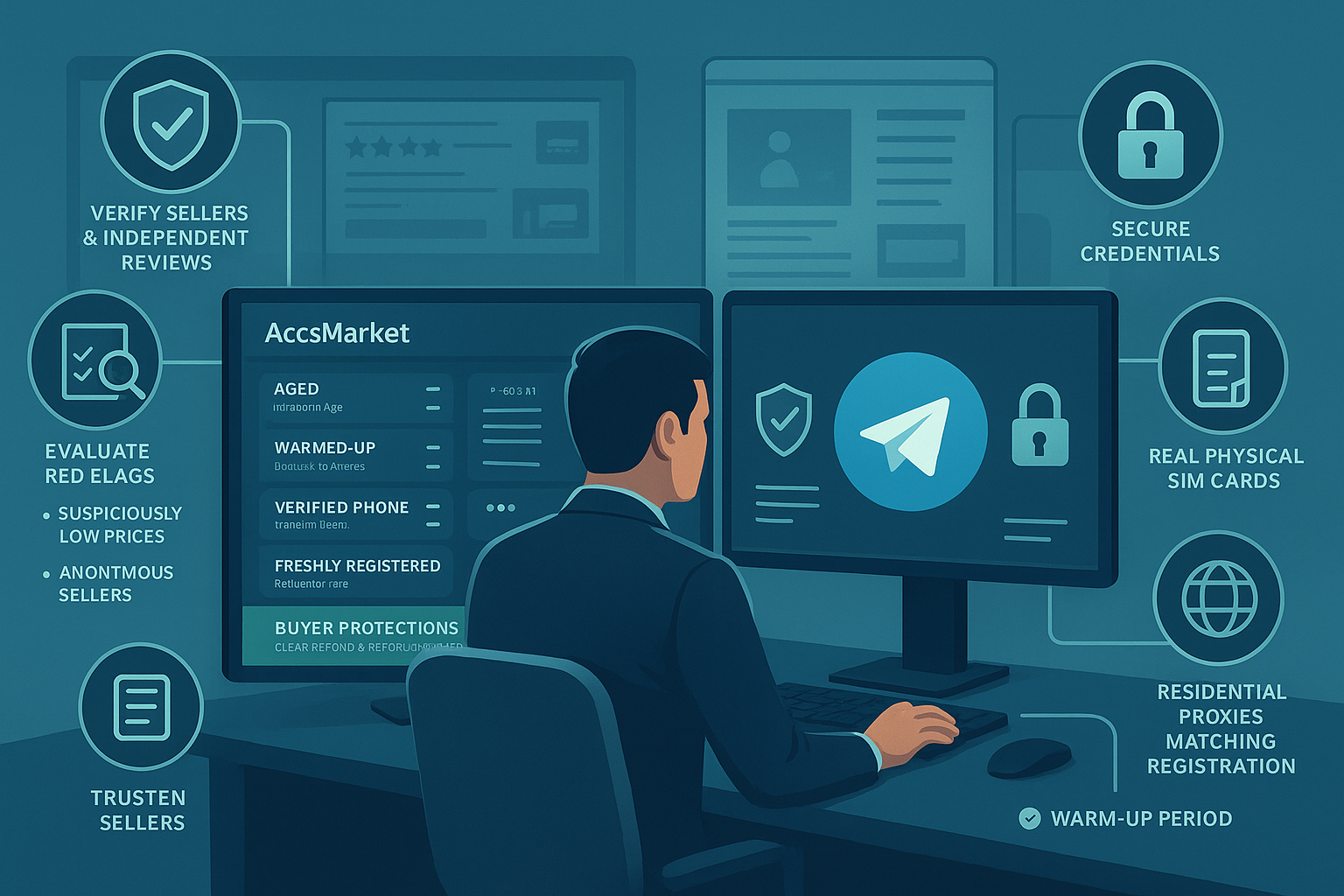
Whether you need accounts for marketing campaigns, bot development, community management, or regional outreach, the process of finding a reliable source is roughly the same - and it starts with understanding the landscape. For those ready to buy telegram accounts, platforms like AccsMarket offer a structured, categorized marketplace where account specifications are clearly listed and buyer protections are part of the service model, rather than an afterthought. That kind of transparency is the baseline you should expect from any seller you seriously consider.
This guide covers every stage of the process: identifying trustworthy telegram account sellers, evaluating marketplace platforms, understanding how registration services work, securing accounts after delivery, and avoiding the most common and costly mistakes. By the end, you will have a practical framework you can apply immediately, regardless of the scale or purpose of your operation.
Why People Purchase Telegram Accounts and What You Need to Know First
The decision to purchase telegram profiles is rarely impulsive. It typically stems from a specific operational need that a single account simply cannot fulfill. Understanding those needs - and matching them to the right account type - is the foundation of a successful acquisition strategy.
Marketers managing multiple client campaigns often need separate accounts for each project to maintain clean attribution and avoid cross-contamination between audiences. Developers building bots and integrations need test accounts that can be created, used, and discarded without affecting live operations. Community managers running several groups simultaneously need dedicated accounts for each environment. Businesses handling customer inquiries at scale use multiple accounts to distribute the workload and reduce response time. And some users simply want additional accounts for privacy, keeping personal and professional communications strictly separate.
Each of these use cases has different technical requirements. A developer testing a bot needs fresh, basic accounts with no history. A community manager needs accounts that can join groups without triggering new-account restrictions. A marketer running automated outreach needs warmed-up accounts with some activity history to reduce the likelihood of being flagged. Buying the wrong type for your purpose is one of the most common and easily avoidable mistakes.
Before any purchase, you also need a clear understanding of Telegram's terms of service. The platform does not explicitly prohibit owning multiple accounts, but it strictly prohibits using them for spam, impersonation, coordinated manipulation, or any form of automated abuse. Violating these terms - regardless of how legitimate your purchase was - results in bans that no seller can reverse. Your investment only holds value if the accounts are used within the boundaries the platform enforces.
- Marketing and outreach campaign management across multiple clients or audiences
- Bot development, API integration testing, and debugging workflows
- Multi-group community moderation with dedicated account roles
- Business customer communication distributed across specialized accounts
- Privacy-focused separation of personal and professional activity
- Region-specific or language-targeted audience engagement
How to Identify Trusted Telegram Account Sellers
The seller you choose determines the quality, stability, and longevity of every account you receive. This is not a secondary consideration - it is the central one. A well-managed account from a reliable seller will outlast a cheap account from an unverified source by a considerable margin, and the cost difference rarely justifies the risk.
Key Signs of a Reputable Seller
Reputable telegram account sellers share a set of characteristics that are easy to verify if you know what to look for. The first is transparency about account origin. A trustworthy seller can tell you clearly how each account was created, what verification method was used, how old the account is, and whether it has any prior activity. Vague answers to these questions are a warning sign, not a minor inconvenience.
The second marker is a clearly stated replacement or refund policy. No account is guaranteed to survive indefinitely, but a seller confident in their product will back it with a defined guarantee period - typically ranging from a few days to several weeks depending on account type and price point. Sellers who offer no guarantee are signaling either low quality or low accountability, and often both.
Third, look for verifiable reviews. Not testimonials hosted exclusively on the seller's own page, but reviews on independent forums, community platforms, or third-party marketplaces where feedback cannot be easily manipulated. A track record of consistent delivery over time is worth more than any marketing claim a seller makes about themselves.
- Transparent disclosure of account creation method and verification source
- Clear, written replacement or refund policy with defined time limits
- Verifiable customer reviews on independent platforms or community forums
- Responsive support that answers pre-sale technical questions
- Detailed account specifications including age, region, and activity status
- Honest pricing with no hidden fees or bait-and-switch tactics
Red Flags and Warning Signs to Avoid
Certain seller behaviors are consistent predictors of a poor outcome. Prices that sit dramatically below the market average are the most obvious signal. Accounts have a real cost of production - phone number verification, device use, registration time, and quality control all factor into what a legitimate seller charges. When a price is inexplicably low, something in that production chain has been cut, and the result is almost always an unstable account.
Anonymous sellers with no platform presence, no history, and no community reputation are another category to avoid entirely. When something goes wrong - and it eventually will - you need a seller you can contact and hold accountable. A seller with no verifiable identity offers no recourse whatsoever.
Be equally cautious of sellers who refuse to provide account details before purchase or who pressure you to buy quickly. A legitimate seller has nothing to hide and no reason to rush you. Urgency-based tactics exist to prevent you from doing the due diligence that would reveal problems.
- Prices significantly below the prevailing market rate with no credible explanation
- No refund, replacement, or guarantee policy of any kind
- Anonymous presence with no verifiable community reputation or reviews
- Refusal to provide account specifications or provenance details before purchase
- High-pressure sales tactics or artificial urgency
- Credentials delivered in unusual or incomplete formats
Comparing Seller Types: Individuals vs. Established Platforms
When searching for accounts, buyers typically encounter two broad categories of seller: individual vendors operating through forums, social media groups, or direct messaging channels, and established marketplace platforms with structured listings, seller ratings, and buyer protection systems. Both have genuine trade-offs, and the right choice depends on your risk tolerance and purchase volume.
Individual sellers occasionally offer lower prices precisely because they have lower overhead. But lower overhead also means fewer quality controls, no formal dispute resolution, and limited accountability if the accounts fail on delivery. For small, one-off purchases where the stakes are low, the risk may be acceptable. For anyone acquiring accounts at scale or for business-critical operations, the absence of formal buyer protections is a serious liability.
Established marketplace platforms impose standards on sellers, maintain rating systems that reflect real buyer experience, and typically offer some form of dispute resolution or refund mechanism. The accounts may cost more, but the consistency is substantially better. The key is ensuring the platform itself is reputable - the existence of a marketplace structure does not automatically guarantee quality if the platform does not actively vet its sellers.
| Criteria | Individual Sellers | Established Marketplace Platforms |
|---|---|---|
| Accountability | Low - difficult to trace or dispute | High - platform enforces standards |
| Price | Often lower | Moderate to higher, reflects quality assurance |
| Account Quality | Variable and unpredictable | More consistent and vetted |
| Refund or Replacement | Rarely offered or honored | Usually part of defined service terms |
| Customer Support | Limited or absent after sale | Structured and accessible |
| Overall Risk Level | Higher | Lower when platform is genuinely reputable |
Understanding Telegram Account Marketplaces
A telegram account marketplace functions as an intermediary layer between buyers and sellers, creating a structured environment where transactions are more predictable and disputes are more manageable. The best platforms do more than simply list accounts - they actively shape the quality of what gets sold through vetting, ratings, and enforced standards.
What a Good Marketplace Should Offer
The most important feature of a reliable marketplace is seller accountability. This means sellers are verified before being allowed to list products, their ratings reflect real buyer feedback, and the platform can intervene when disputes arise. A marketplace that allows any seller to list accounts without oversight is only marginally safer than buying from a random individual.
Beyond accountability, look for clear account categorization. A useful marketplace organizes listings by account type, age, region, verification method, and activity status, so buyers can filter results by their specific requirements rather than sifting through undifferentiated listings. Secure payment processing and some form of buyer escrow or purchase protection are also markers of a platform that takes its role seriously.
- Seller verification and rating systems based on real transaction history
- Account categorization by type, region, age, and verification method
- Escrow or buyer protection mechanisms for dispute resolution
- Clear terms covering refunds, replacements, and delivery standards
- Secure payment options with documented transaction records
- Detailed account descriptions with complete specifications
Types of Accounts Available on Marketplaces
Not every account sold on a telegram account marketplace serves the same purpose, and treating them as interchangeable is a reliable path to disappointment. Account type should be matched to intended use before any purchasing decision is made.
Freshly registered accounts are new, have no activity history, and are the most affordable option. They work well for testing and development but carry higher ban risk when used for outreach because Telegram's systems apply more scrutiny to new accounts performing high-volume actions. Aged accounts, by contrast, have months or years of registration history, which increases the platform's implicit trust in them and makes them significantly more suitable for community management or channel building.
Warmed-up accounts occupy a middle ground - they are relatively recent but have been used in a controlled way to simulate natural activity before sale. Verified phone accounts, registered using real physical SIM cards rather than virtual numbers, are the most stable category and command the highest prices for that reason. Region-specific accounts allow buyers to match the account's registration geography to a target audience, which matters for campaigns where local credibility or compliance is relevant.
| Account Type | Description | Best Use Case |
|---|---|---|
| Freshly Registered | New accounts with no prior activity history | Development testing, low-stakes trials |
| Aged Accounts | Registered months or years before sale | Channel management, community building |
| Warmed-Up Accounts | Pre-sale activity simulates natural use patterns | Outreach automation with lower spam risk |
| Verified Phone Accounts | Registered using real physical SIM cards | High-trust operations requiring stability |
| Region-Specific Accounts | Phone numbers from targeted countries | Geo-targeted campaigns and local outreach |
How Telegram User Registration Services Work
An alternative to buying pre-existing accounts is working with telegram user registration services - providers that create accounts on your behalf using phone number verification processes they manage directly. This approach gives buyers more control over account specifications but introduces its own set of variables that need to be understood before committing to this route.
Manual vs. Automated Registration
Registration services fall along a spectrum from fully manual to fully automated. In a manual process, a human operator registers each account individually on a real device, completing the verification steps the way any ordinary user would. This produces accounts that look and behave like genuine user registrations because they are. The trade-off is time and cost - manual registration does not scale cheaply.
Automated registration uses software to create accounts in bulk, processing verification steps at a pace and volume no human could match. The accounts are cheaper and delivered faster, but the registration pattern is more likely to resemble what Telegram's systems flag as suspicious activity. Accounts created in rapid automated batches from the same IP address or device pool are at higher risk of early detection and restriction. For most serious operations, the marginal savings from automated registration rarely justify the elevated instability.
Phone Number Verification and SIM Options
Every Telegram account requires a valid phone number for initial verification, and the source of that number is one of the strongest predictors of account longevity. Registration services use three primary methods, each with distinct trade-offs in quality, cost, and availability.
Real physical SIM cards, used in actual mobile devices, produce the most stable accounts. The verification pattern is indistinguishable from a genuine new user because it is one. These accounts cost more to produce and require more time, but they hold up under Telegram's periodic security reviews far better than alternatives.
Virtual number services provide temporary phone numbers that receive SMS verification codes without a physical SIM card. They are faster, cheaper, and work for many use cases, but the numbers are often reused across multiple registrations. Telegram tracks number reuse patterns, and accounts registered on frequently recycled virtual numbers are more likely to be flagged or restricted early.
Provider-managed number pools sit somewhere in between. The quality depends heavily on how long those numbers have been in the pool, how often they have been reused, and whether the provider actively retires numbers that have been flagged. A provider with disciplined pool management can deliver reasonable quality at a competitive price. One without it will deliver variable results that are difficult to predict before the accounts are tested in real conditions.
- Real SIM cards - highest stability, highest cost, slowest production rate
- Virtual numbers - moderate quality, affordable, faster but dependent on reuse rate
- Provider-managed number pools - variable quality based on pool hygiene and management practices
What to Ask a Registration Service Before Buying
Before committing to any telegram user registration service, a short but targeted set of questions will tell you most of what you need to know about their quality and reliability. Providers who answer clearly and specifically are worth considering further. Those who deflect, generalize, or become evasive about operational details are not.
- What phone number source do you use for verification - real SIM, virtual numbers, or a managed pool?
- Are accounts registered manually by human operators or through automated software?
- What is the typical lifespan of accounts you deliver under normal usage conditions?
- Do you offer replacements if accounts are banned within a defined period after delivery?
- Can you register accounts with phone numbers from specific countries or regions?
- In what format are credentials delivered, and what login information is included?
- Can you provide references or independently verifiable reviews from previous clients?
Step-by-Step Process for Safely Purchasing Telegram Accounts
Having researched sellers and account types, the next challenge is executing the purchase in a way that minimizes risk and validates quality before committing to scale. The following sequence applies whether you are acquiring a handful of accounts for a small project or hundreds for a large operation.
- Define your requirements precisely. Determine how many accounts you need, what type suits your use case, which regions matter, and what your tolerance is for account turnover. Specificity at this stage saves money and prevents mismatched purchases.
- Research and shortlist potential sources. Use community forums, independent review platforms, and peer recommendations to identify sellers or marketplaces with documented track records. Do not rely solely on a seller's own website for reputation information.
- Verify seller legitimacy independently. Check ratings, read reviews across multiple sources, confirm the existence and terms of any guarantee policy, and look for patterns in negative feedback that might indicate systemic quality problems.
- Request full account specifications before purchasing. Ask for registration date, verification method, region, activity history, and the exact format of credentials you will receive. Any reputable seller can provide this information.
- Start with a small test order. Regardless of how credible a seller appears, purchase a small batch first. Test the accounts in real conditions - join groups, send messages, wait several days - before placing a larger order.
- Secure accounts immediately after delivery. Change any default or shared passwords, store credentials in an encrypted password manager, and document all account details in a secure internal record.
- Monitor for initial stability. Watch accounts closely during the first week. Any bans or login failures that occur within the seller's guarantee period should be reported promptly with documentation to support a replacement or refund claim.
- Scale only after validation. Once a test batch proves reliable under your specific usage conditions, proceed with larger orders from the same verified source.
Security Practices After You Purchase Telegram Profiles
The purchase itself is only part of the equation. Accounts that are poorly managed after delivery fail at rates that have nothing to do with the seller's quality - they fail because of how they are handled. Establishing consistent security and operational practices from the moment accounts land in your possession dramatically extends their useful life.
Protecting Account Credentials
Treat purchased account credentials as sensitive business assets, because that is what they are. Store them in an encrypted password manager rather than spreadsheets, notes applications, or shared documents. Never transmit credentials over unencrypted channels such as standard email or casual messaging apps.
Where possible, assign each account to a dedicated device or virtual machine. Running multiple accounts from a single browser session or unprotected device creates a connection between them that Telegram's systems can detect. When accounts are linked by shared device fingerprints, a ban on one can trigger scrutiny on others. Isolation is not paranoia - it is standard practice for anyone managing accounts at any meaningful scale.
Using Proxies and VPNs Responsibly
IP address behavior is one of the signals Telegram uses to assess account legitimacy. An account registered in one country that is consistently accessed from a different country raises flags, particularly when that access pattern begins immediately after the account is first used. Matching your access IP to the account's registration region, using residential proxies rather than datacenter alternatives, significantly reduces this risk.
Residential proxies are harder to identify as proxy traffic and carry lower detection risk than datacenter IP addresses, which Telegram's infrastructure recognizes more readily. Avoid routing too many accounts through a single proxy simultaneously - the volume of distinct accounts operating from one IP is itself a detectable pattern.
- Use residential proxies in preference to datacenter proxies for lower detection risk
- Match proxy geography to the account's registration country where operationally possible
- Distribute accounts across multiple proxies rather than concentrating them on one
- Rotate proxies periodically to prevent long-term behavioral pattern detection
Avoiding Behaviors That Trigger Account Bans
Even a well-sourced, properly secured account will not survive aggressive misuse. Telegram's automated systems are calibrated to detect unnatural usage patterns, and certain behaviors reliably trigger them regardless of account age or quality.
Sending large volumes of unsolicited messages immediately after activation is the most common cause of early bans. New accounts - even aged ones accessed for the first time after purchase - benefit from a warm-up period of natural-seeming activity before any high-volume action begins. Joining multiple groups in rapid succession, particularly groups unrelated to each other, mimics the behavior of automated spam accounts and is flagged accordingly.
Automation tools that replicate human behavior poorly - moving too fast, following identical sequences, operating at hours inconsistent with the account's claimed region - accelerate detection. If automation is part of your workflow, invest time in configuring it to behave as a human user would, including realistic delays, varied action sequences, and activity patterns consistent with the account's apparent origin.
- Allow a warm-up period before high-volume actions on any newly activated account
- Avoid joining multiple unrelated groups in rapid succession
- Configure automation tools to replicate human-like timing and action variation
- Do not log in from multiple different IP addresses in a short window
- Avoid identical behavioral patterns across multiple accounts operating simultaneously
Evaluating Cost vs. Quality When You Acquire Telegram Users
Price comparison is a natural starting point for any purchasing decision, but in the account market it is a particularly unreliable guide when used in isolation. The actual cost of an account is not what you pay at checkout - it is what you pay divided by how long the account remains functional and useful. A cheap account that lasts three days costs more, per day of operation, than a well-priced account that remains stable for six months.
The factors that legitimately drive account prices upward are also the factors that predict longevity. Account age matters because older registrations have a longer history that Telegram's systems associate with legitimate users. Verification method matters because real SIM registrations are more trusted than virtual number registrations. Regional pricing reflects the availability and cost of phone numbers in different markets, not arbitrary pricing decisions. Sellers who charge more for warmed-up accounts are charging for the time and resources spent creating activity history - and that history has real value when you are trying to avoid immediate spam flagging.
Guarantee terms should also factor into your cost calculation. A seller offering a 30-day replacement guarantee is implicitly confident in their account quality in a way that a no-guarantee seller is not. If a batch of accounts fails within the guarantee window and is replaced at no cost, the effective cost per functional account drops substantially compared to a cheaper initial price with no safety net.
| Price Factor | Impact on Account Quality | Buyer Consideration |
|---|---|---|
| Account Age | Older accounts carry higher implicit trust | Worth the premium for long-term or critical use |
| Verification Method | Real SIM produces more stable accounts than virtual numbers | Prioritize real SIM for high-value operations |
| Region of Phone Number | Affects trust signals and geo-matching reliability | Match region to your target audience or use case |
| Activity History | Warmed-up accounts resist early spam detection better | Essential when automation or outreach is planned |
| Seller Guarantee Terms | Longer guarantees reflect seller confidence in quality | Factor replacement value into the total cost assessment |
Questions and Answers
Is buying Telegram accounts against the platform's rules?
Telegram does not have an explicit prohibition on account ownership transfer, but it strictly prohibits using accounts for spam, fraud, and automated abuse. The risk is not in the purchase itself but in how the accounts are subsequently used. Operating within the platform's behavioral guidelines is what determines whether accounts survive long-term, regardless of how they were obtained.
How do I verify that a purchased account has not already been flagged by Telegram before I use it?
After receiving credentials, log in and attempt basic actions: send a test message, try joining a small group, and check whether the account can access standard features without immediate restrictions. Accounts that are already flagged will typically show limitations immediately upon login - such as being prevented from joining groups or sending messages to non-contacts. Running this check before deploying accounts into any live workflow takes minutes and can save significant time and money.
What is the realistic lifespan of a purchased Telegram account?
Lifespan depends on account type, the verification method used at registration, and how the account is operated after purchase. A freshly registered account used immediately for high-volume outreach may last days. An aged, real-SIM-verified account managed carefully with proper proxy use and a warm-up period can remain functional for months or longer. The single largest variable is user behavior after delivery - even premium accounts fail quickly under aggressive or unnatural use patterns.
Can I use purchased accounts with third-party automation tools?
Yes, but the configuration matters considerably. Automation tools that operate at unrealistic speeds, follow rigid identical sequences across multiple accounts, or ignore human-like timing patterns are highly effective at triggering Telegram's detection systems. Any automation workflow applied to purchased accounts should include variable delays, natural activity pacing, and proper IP isolation per account. Testing automation on a small batch before scaling to a full set is standard practice for anyone running accounts at volume.
What should I do immediately if a purchased account gets banned within the seller's guarantee period?
Document the issue first - take screenshots of the account status and any error messages Telegram displays. Then contact the seller through the channel you used for the original transaction, referencing the order details and the guarantee terms you agreed to before purchase. Most reputable sellers require this kind of documentation to process replacements. If the seller is unresponsive or refuses to honor a written guarantee, escalate through the marketplace platform if that is where the transaction took place, as most structured platforms have a formal dispute process available to buyers.
Does the country of the phone number used for registration actually affect account performance?
It can, particularly for geo-targeted campaigns where local credibility matters to recipients, or for operations where the access IP and registration region need to match to avoid triggering location-based security flags. Region also affects number availability and cost, which is why accounts registered on numbers from certain markets carry price premiums. For purely technical use cases like bot testing, regional origin is less critical than it is for outreach or community management in specific geographic markets.